
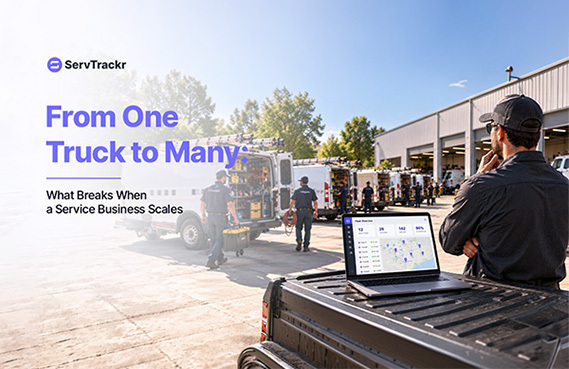
Running one truck is hard in a personal way — you're doing the work, keeping the schedule, and chasing the invoices yourself. Running three or four trucks is hard in a different way: the systems that worked fine when you personally remembered everything start quietly breaking once someone else is in the truck.
What Worked at One Truck (And Why It Stops Working)
At one truck, you kept the whole day in your head. A second and third crew means someone else needs that same picture — and "someone else" usually doesn't have it. Customers used to deal with you directly; now they might get a technician who's never met them, with no history to fall back on. Pricing "felt right" because you were the one doing every estimate yourself; once a new hire is building quotes without a clear framework, pricing starts to drift and vary job to job.
The Cracks That Show Up First
- Double-booked crews, because there's no single shared schedule everyone works from.
- Inconsistent quotes, because pricing knowledge lived in one person's head instead of a documented process.
- Lost customer and job history, because it was never written down anywhere durable — just remembered.
- No clear visibility into which crews or job types are actually profitable, versus just busy.
What to Put in Place Before You Scale Further
- A shared, live schedule and dispatch board — not a whiteboard only one person updates.
- A documented pricing framework new hires can actually follow, built from labor, materials, overhead, and target margin.
- Customer and job history attached to the account, not to any one person's memory.
- Visibility into which crews and jobs are actually profitable, so growth means more revenue at healthy margins — not just more revenue at the same thin ones.
How ServTrackr Supports Growing Teams
Team management in ServTrackr keeps everyone — office staff and technicians — working from the same live schedule and dispatch board, so adding a second or third crew doesn't mean adding a second version of the truth. Client CRM keeps customer and job history attached to the account itself, so a new technician isn't starting from zero with a customer they've never met. And real-time profit tracking shows margin per job, which becomes far more important once you're trying to compare how different crews or job types are actually performing.
FAQ
At what size does a service business typically need dedicated software instead of manual systems? There's no fixed number, but the warning signs — double-booking, inconsistent pricing, lost customer history — tend to show up as soon as more than one person is scheduling or quoting work, often somewhere around the second or third truck.
How do I keep pricing consistent once someone besides me is building estimates? Build a documented pricing framework — labor, materials, overhead, and target margin — and turn it into templates in your estimating tool, so a new hire is filling in a structure rather than guessing at a number.
Give your growing team one shared system to work from. Start a free 14-day trial of ServTrackr — no credit card required.