
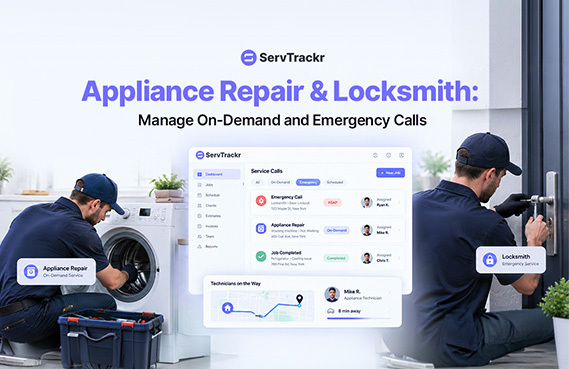
Appliance repair and locksmith businesses share a pattern most trades don't: almost every call is reactive. A washer stops working, or someone's locked out, and the expectation is usually "can you come today." That kind of unpredictable, on-demand call volume is hard to manage well without a system built for it.
The On-Demand Challenge
For appliance repair, the real scope of a job — and the price — often isn't clear until a technician is standing in front of the unit, doing a diagnostic-to-quote right there on the truck. For locksmiths, lockout dispatch, whether residential, automotive, or commercial, is inherently urgent and frequently happens after hours. In both trades, response speed matters as much as the repair itself, since a slow callback usually means the customer has already called the next business in the search results.
What Falls Through the Cracks Without a System
A part gets ordered for a warranty repair, but the follow-up visit never gets scheduled because it wasn't tracked separately from a standard job. A recurring commercial locksmith client's key and lock history lives in someone's memory instead of a written record, so every visit starts from scratch. An after-hours emergency call gets handled on the spot, but the invoice never actually goes out because it was never logged in the regular system to begin with.
4 Ways Software Helps Reactive, On-Demand Trades
- Centralize every inbound request — call, form, or message — so nothing gets lost, especially after normal business hours when a missed call is most likely to become a missed job.
- Dispatch based on live technician location for the fastest possible response, which matters as much for a lockout as it does for a broken refrigerator.
- Keep a record of past jobs and client history in one place, including warranty work tracked separately from standard repairs, or a recurring commercial account's full lock and key history.
- Generate the invoice and take payment on the spot, so an emergency call doesn't turn into a forgotten invoice a week later.
What This Looks Like With ServTrackr
Every appliance repair or locksmith request — however it comes in — is logged automatically, and the live dispatch board sends the closest available technician, day or night. ServTrackr's Client CRM keeps a record tied to each customer, so warranty work stays separate from standard repairs, and a commercial locksmith client's lock history is there the next time they call instead of living in someone's memory. Once the job is done, the invoice generates automatically, with the option for the customer to pay by card or ACH before the technician leaves.
FAQ
How does this help with after-hours emergency calls? A centralized request system, paired with a mobile app, means an after-hours call gets logged and can be acted on the same way a daytime call would, instead of sitting in a voicemail until the next morning. An actual after-hours answering process is still a separate business decision, but the software makes sure nothing that does come in gets lost.
Can I keep notes on a customer for next time, like an appliance model or a property's lock system? Yes. ServTrackr's Client CRM keeps a record of past jobs tied to each customer, so that history is there the next time they call.
See how ServTrackr handles on-demand and emergency calls. Start a free 14-day trial — no credit card required.