
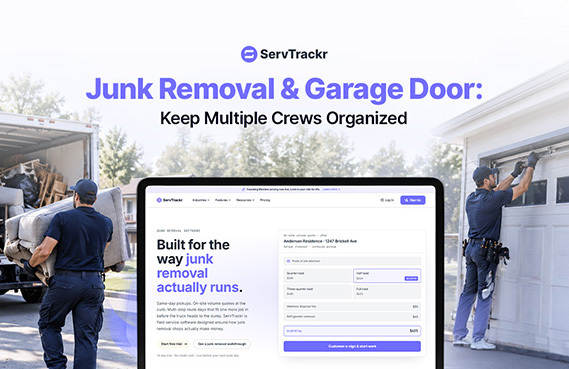
Junk removal and garage door repair look like different businesses, but they run on a similar model: fast, single-visit jobs, usually re-quoted once the crew is actually looking at the job, where volume matters more than any single ticket. In both trades, the speed between "job done" and "money in the bank" has an outsized effect on how many jobs a crew can fit into a day.
Why Speed Matters More in These Trades
Junk removal typically runs on volume-based pricing — what's actually being hauled away often isn't clear until the crew is standing in the garage or driveway. Garage door work spans everything from a quick spring replacement to a full opener install to an emergency service call, each with a very different price tag. Both are volume-driven, lower-ticket, higher-frequency businesses compared to project-based trades, which means administrative drag on any single job hurts more — it's not one big project absorbing the cost of slow paperwork, it's twenty smaller jobs each losing a little time.
The On-Site Quoting Problem
For junk removal, price depends on volume, weight, and item type — genuinely hard to pin down over the phone. For garage door work, the difference between a spring replacement, an opener install, and a full door replacement is significant, and it's often not clear which one is needed until someone's actually looking at the door. Without a fast way to confirm a real price on-site, crews either eat the difference or have an uncomfortable conversation at the customer's door.
4 Ways Software Speeds Up the Quote-to-Payment Cycle
- Capture the initial request with as much detail as possible up front — job type, address, and photos if the customer can provide them — so the crew isn't walking in blind.
- Build or revise the estimate on-site. Once the crew can see the actual job, a digital estimate built and signed from a phone replaces whatever was quoted over the phone.
- Auto-generate the invoice from the approved, final estimate. There's no separate invoicing step to do later, since the numbers are already locked in.
- Accept payment before leaving the property, by card or ACH through a client portal, instead of invoicing "later" and hoping it gets paid promptly.
What This Looks Like With ServTrackr
A junk removal or garage door request comes in through a form, call, or message and is logged as a Request with whatever details the customer provides. On-site, the crew builds or adjusts a digital Estimate on their phone and gets it signed on the spot. Once approved, the completed job flows straight into an Invoice, and the customer can pay immediately by card or ACH — all in the same platform, whether the job is a $150 haul-away or a $600 opener install.
FAQ
Our price almost always changes once we see the job — can software handle that? Yes. You can build or adjust the estimate on-site based on what the crew actually finds, and get it approved on the spot rather than relying on the original phone quote.
Do junk removal and garage door businesses need different software since they're different trades? No. Both run on the same underlying workflow — capture the request, quote on-site, invoice, get paid — so one platform can serve either without needing separate tools.
See the same-day quote-to-payment flow for yourself. Start a free 14-day trial — no credit card required.